When CoStar took the measure of the Boise region's apartment market, the headline finding wasn't about the metro. It was about a single suburb. Meridian, by itself, accounts for almost half of the entire region's apartment demand. For a firm that underwrites to submarkets rather than metros, that one sentence is close to the whole thesis — and it changes where multifamily capital should actually go.
One Suburb, Half the Demand
In its March 2025 read on the Boise market, CoStar reported that Meridian makes up almost half of the region's apartment demand, with leasing strengthening and new supply set to taper after the 2024 delivery wave pushed vacancy up through that year. Sit with the proportion for a moment. Meridian is one of several cities in the Treasure Valley, and it absorbs apartment demand at a rate wildly out of step with its share of the map.
Nationally, that pattern is unusual. In most metros, demand is distributed across the urban core and a ring of suburbs, and no single suburb dominates absorption. The Treasure Valley does not work that way. The demand is lopsided toward the west, and Meridian is the center of gravity. That is not a rounding artifact or a single strong quarter. It is a structural feature of how households in the Valley are forming and where they are choosing to land.
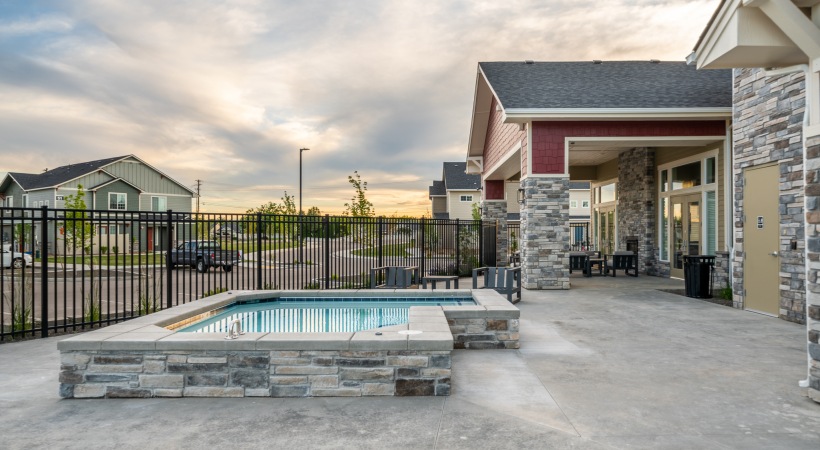
We have watched it from inside our own operations. The Enclave sits in Meridian for the same reason the demand data points there — this is where the renters are, and, more importantly, where they stay. Absorption tells you where people move. Retention tells you whether the demand is real. In Meridian, both point the same direction.
Why Demand Pools Here
The concentration has real drivers behind it, not momentum:
- In-migration geography. The net inflows from California and the Pacific Northwest that have defined the Valley for a decade keep landing in its western half, where new rooftops, retail, and employment are densest.
- Household formation. Meridian skews toward household-forming renters rather than transient ones — the kind of demand that shows up as two- and three-bedroom absorption, not studio churn.
- Job and retail geography. Employment and daily-needs retail have concentrated around Ten Mile and the Village, putting a deep renter base within a short commute of where it wants to live.
- Product scarcity. Much of Meridian's renter base wants family-sized space, and that inventory is structurally tighter than one-bedroom product across the Valley.
What matters about that list is its durability. None of those drivers reverses on a single rate move or a soft leasing quarter. Migration patterns, employment geography, and the shape of the renter base change over years, not months. That is what separates a demand concentration worth underwriting to from a hot submarket that mean-reverts the moment concessions appear.
The last point is the one we built around. The Enclave's even split between two- and three-bedroom homes isn't a design preference — it sits at the exact part of the demand curve that is hardest to satisfy and slowest to turn.
Demand that concentrates in one submarket is both a gift and a trap. The gift is durable absorption. The trap is that supply hears the same signal you do.
The Supply Is Following the Demand
Here is the risk the headline number hides. When one submarket absorbs half a region's demand, capital notices — and the 2026 entitlement pipeline shows it plainly. In May 2026, Meridian approved a roughly 200-unit apartment project on Overland Road, and large-scale residential development in North Meridian is moving through the city's pre-application process. The same gravity that makes Meridian the best place in the Valley to own apartments makes it the most contested place to build them.
That sets up the timing question every Meridian underwrite has to resolve. The 2024 wave pushed vacancy up and is now tapering, which is the constructive part of the story. But the demand concentration is pulling the next round of supply right back into the same corridors. Concentrated demand and concentrated new supply can occupy the same three-mile radius — you are often buying into the strongest demand in the region and into the path of the most new product at the same time.
What This Means for Owners and Capital
The concentration cuts both ways, and the discipline is the one we laid out in our Q2 Treasure Valley outlook: underwrite to the submarket, not the metro average.
- Distance to the new-supply corridor matters more than the metro vacancy rate. A building a few miles off the delivery path competes in a different market than the headline suggests.
- Unit mix matters, because family-sized inventory competes against a thinner new-supply set than one-bedroom product does.
- Basis matters, because paying a Meridian premium only works if you have underwritten the 2026–2027 lease-up trough honestly rather than assuming the demand story carries you through it.
This is also why the concentration favors patient capital over flip capital. A short-cycle buyer needs the demand story to pay off inside three years, which is exactly the window the next supply wave is most likely to disrupt. A long-hold owner can absorb a soft 2026–2027 lease-up and re-emerge into a thinner competitive set with the demand engine still running underneath. For capital partners, the takeaway is that “Boise” is not the unit of analysis. Meridian is. And within Meridian, the corridor is.
What We're Watching
- Lease-up concession depth on the 2026 Meridian deliveries — the first eight weeks of any new property tell you more about real market depth than its asking rents do.
- Whether absorption stays concentrated in Meridian or begins to spread to Kuna, Star, and Caldwell as Meridian prices up.
- Entitlement-to-start conversion — how much of the approved pipeline actually breaks ground given where debt costs sit.
- Renewal behavior in family-sized product, where we expect retention to hold through the supply wave (the logic is in our retention piece).
Meridian is where we built, where we operate, and where we are developing Arete. The demand concentration is the reason. Whether supply overshoots it is the question we are underwriting against every quarter — subscribe below for the Q3 scan.